protocol
Context Graph Protocol
Two systems exchange data. This protocol determines whether they mean the same thing. The purpose of this protocol is the smallest possible variables and complexity that supports the maximum generalizability across context.
For more info, see the paper on Liquid Mesh Folding
Base URI: https://w3c-context-graph-community-group.github.io/protocol/
Prefix: cg: (Context Graph)
Version: 0.7 — April 2026
Status: Working draft.
The Problem: Uncertainty at System Boundary Communication
A system is anything with its own codebook — its own way of interpreting data. A person, an API, a database, a spreadsheet.
When two systems exchange data, both assume they mean the same thing. That assumption is never checked. When it’s wrong, everything downstream is confidently wrong — and nothing in either system can detect it.
The information needed to verify the assumption is on the other side of the boundary.
The Fix
Put an instrument at the boundary. Let it ask.
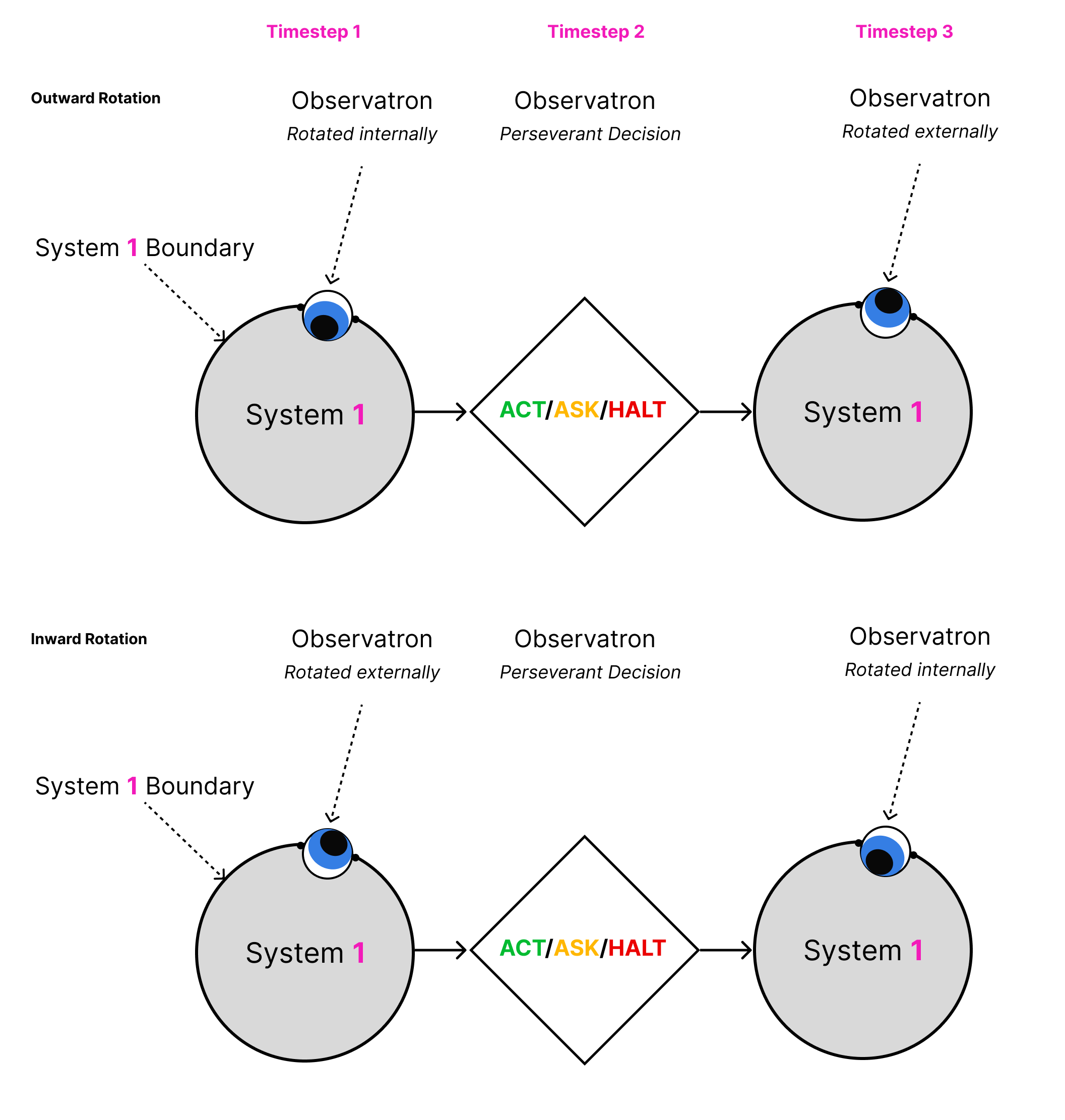
The observatron sits on the boundary of a system. It rotates inward to check the codebook, decides (Act, Ask, or Halt), then rotates outward to communicate across the boundary. Every rotation produces a recorded claim.
How It Works
1. Instantiate an observatron
The observatron is the protocol’s measurement instrument. Your system creates one and grants it access to your codebook.
source = cg:protocol/observatron/source/<system_1:id>
If you don’t provide a name, one is auto-generated.
2. Deploy it at a boundary
Point the observatron at the system you’re exchanging data with. This assigns a boundary id.
id = cg:protocol/boundary/<system_1>-<other system(s):id>
The observatron now has two channels: inward (system_1 codebook) and outward (other system(s) signals).
3. Handshake
Unilateral is the only requirement, if there is no handshake, then there are no other systems available for it to interact with. The parent system needs to provide an id & source or one is auto-generated.
Bilateral — both sides run the protocol. Cryptographic nonce exchange proves receipt.
SYN       →  value: 7a3f9b2e (nonce)
SYN-ACK   ←  value: c4d5e6f7:sha256(7a3f9b2e)
ACK       →  value: sha256(c4d5e6f7)
Unilateral — the other side doesn’t run the protocol (a human, a legacy API). Your observatron still logs the handshake, recording observed signals instead of protocol responses.
4. Evaluate four facets
Each facet is compared in dependency order. If an upstream facet fails, downstream evaluation stops.
Assertions of the four facet model
The decision tree:
context   →  Are we in the same reference frame?      if FALSE → Halt
meaning   →  Do we mean the same thing?               if FALSE → Ask
structure →  Is it encoded the same way?              if FALSE → Ask
data      →  Does the value match?                    if FALSE → Ask
                                                      ELSE ACT
Halt = can’t reason here. Ask = need more information. Act = codebooks aligned, proceed.
5. Record every measurement
Every ask, response, and verdict is a canonical claim — one row, five columns:
| id | source | timestamp | key | value |
|---|---|---|---|---|
| boundary URI | observatron URI | ISO 8601 UTC | facet URI | the assertion |
Claims sharing an (id, key) pair form a hyperedge in the graph. Edges exist only because measurements were made. Absent edges are unmeasured boundaries.
6. Close
FIN       →  value: reason:complete
FIN-ACK   ←  value: ack
The full trace — SYN to FIN-ACK — is your audit trail.
Three Boundary States
Every boundary facet you haven’t measured is in one of these states:
State What it means What it looks like from inside Null Uncertainty No facets are registered. No axes exist for measurement. Confidence. No alarm. The configuration space is undefined — not large, but absent. Dark Uncertainty Facets are registered and axes exist, but positions have Known gap. not been verified. The system is somewhere in the configuration space but does not know where. Collapsed Uncertainty All facets have been verified. The system occupies a single Confidence. No alarm. known point in the configuration space.
Null uncertainty and collapsed uncertainty are indistinguishable from inside. That’s the problem this protocol solves.
Coherence Coverage
C = |E| / N
| E | = boundary facets measured. N = total boundary facets. C ∈ [0, 1]. |
| C measures awareness, not correctness. Two systems measured and found misaligned still contribute to | E | . The graph shows you exactly which facets remain unmeasured. |
Vocabulary
37 definitions. 185 dereferenceable URIs.
| Path | What it defines | Count |
|---|---|---|
substrate/ |
The five canonical columns: id, source, timestamp, key, value | 5 |
facet/ |
The four comparison facets: context, meaning, structure, data | 4 |
epistemic/ |
Three boundary states: null, undefined, verified | 3 |
protocol/ |
Reasoning modes (halt, ask, act) and verbs (syn, syn-ack, ack, fin, fin-ack, halt, timeout) | 10 |
handshake/ |
Two modes: bilateral, unilateral | 2 |
lifecycle/ |
Two setup steps: instantiation, deployment | 2 |
connection/ |
Seven connection states | 7 |
operation/ |
Rotation: the unit of measurement | 1 |
metric/ |
Coherence coverage: C = |E|/N | 1 |
rule/ |
No edge without rotation | 1 |
model/ |
The observatron’s intent map (decision engine) | 1 |
Quick Start
# Clone the protocol
git clone https://github.com/W3C-Context-Graph-Community-Group/protocol.git ~/w3c/cg/protocol

# Clone the log (where observed claims go)
git clone https://github.com/W3C-Context-Graph-Community-Group/log.git ~/w3c/cg/log

# Clone the demo (working example)
git clone https://github.com/W3C-Context-Graph-Community-Group/demo.git ~/w3c/cg/demo
The protocol repo is definitions. The log repo is observations. The demo repo is implementation. Definitions are not instances.
Links
- Paper: Liquid Hypergraphs: A Context Graph Protocol (working draft)
- W3C Community Group: W3C Context Graph Community Group
- GitHub: W3C-Context-Graph-Community-Group